
When anxiety keeps your body on alert, trauma leaves you feeling disconnected, or mental fog makes even ordinary tasks feel heavy, you may want support that reaches beyond talking alone. LENS neurofeedback versus biofeedback is a common question for people looking for practical, brain-body-based tools alongside counseling. While both approaches can build awareness and support regulation, they work in distinctly different ways.
The best choice is not necessarily the newest method or the one someone else found helpful. It is the approach that fits your symptoms, comfort level, goals, health history, and the kind of support you need right now. For many people, this decision becomes less confusing once they understand what happens in each type of session.
LENS Neurofeedback Versus Biofeedback: The Core Difference
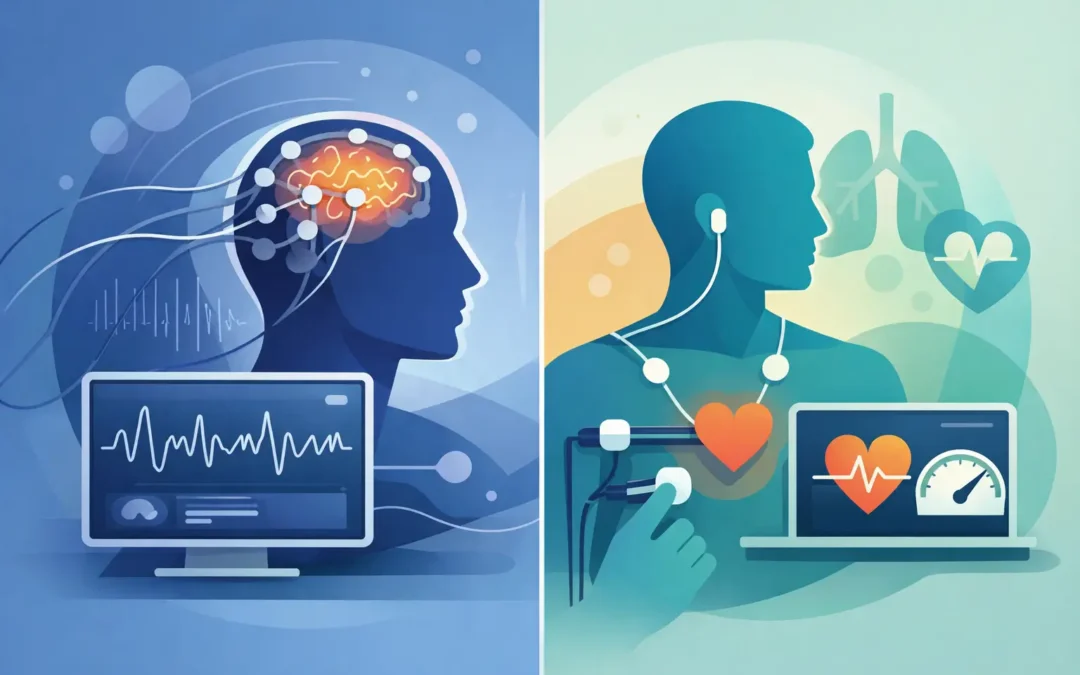
Biofeedback teaches you to notice and influence signals from your body. Sensors may track measures such as heart rate, breathing, muscle tension, skin temperature, or skin conductance. You see or hear feedback in real time, then practice a skill – perhaps slower breathing, releasing your shoulders, or grounding your attention – to shift that signal.
LENS neurofeedback, short for Low Energy Neurofeedback System, is a type of neurofeedback that uses EEG sensors to read patterns of brain activity. During a session, the system provides very brief, low-intensity feedback based on the brain’s own activity. Unlike many traditional neurofeedback approaches, LENS generally does not ask you to consciously control a game, video, sound, or brainwave pattern.
That distinction matters. Biofeedback is often an active learning process: you practice a regulation skill and watch your body respond. LENS is typically more passive: you sit comfortably while the provider monitors the session and adjusts the protocol based on your response and goals.
Neither approach asks you to force yourself into calm. Both can be used as supportive tools for people whose nervous systems have spent too long in survival mode. But the experience and emphasis are different.
What Biofeedback Can Help You Practice
Biofeedback can make the invisible visible. If you have ever felt your chest tighten during a difficult conversation, noticed a headache building after a stressful week, or realized you hold your breath when overwhelmed, you already know that emotional strain shows up in the body.
In a biofeedback session, seeing those patterns on a screen can help turn a vague feeling of “I am stressed” into useful information. You might learn that your breathing becomes shallow when your mind races, or that your muscle tension drops when you use a particular grounding exercise. Over time, this feedback can help you recognize your early warning signs and use skills before stress takes over the rest of your day.
Biofeedback may be a good fit for someone who wants to be actively involved in learning relaxation and self-regulation strategies. It can pair especially well with counseling because the tools are concrete and portable. You can practice them before sleep, during a work break, before a hard conversation, or while moving through a grief wave.
Its trade-off is that it requires participation and practice. If you are exhausted, highly activated, or struggling to focus, it may feel difficult to apply a new skill in the moment. That does not mean you are failing. It may simply mean you need support that meets your system at a different starting point.
What a LENS Neurofeedback Session Feels Like
A LENS session is usually quiet and straightforward. A provider places sensors on specific areas of the scalp to measure EEG activity. The sensors read activity; they do not put electricity into your brain. Brief feedback is delivered through the system, often in very short intervals, while the provider observes how you are doing.
People commonly ask whether they have to try to relax, think positive thoughts, or perform well during LENS. The answer is no. You do not need to make your brain do anything. You can simply show up as you are – tired, skeptical, restless, hopeful, or unsure.
Because LENS is individualized, session length, sensor placement, and pacing may vary. Some people report feeling calmer, clearer, more rested, or more emotionally steady after sessions. Others notice temporary fatigue, increased emotion, headache, vivid dreams, or no immediate change. Responses are personal, which is why thoughtful screening, careful pacing, and ongoing communication with a trained provider matter.
LENS is often appealing to people who feel that they understand their patterns intellectually but still cannot seem to shift them. You may know why anxiety is happening and still wake up braced for danger. You may have spent years talking about a trauma and still feel your body react as though it is happening now. Brain-based support can be one part of helping the nervous system find a new rhythm.
Is One Better Than the Other?
LENS neurofeedback and biofeedback are not competing answers to the same problem. They can serve different needs, and in some care plans, they may complement one another.
Biofeedback may be especially useful when you want skills you can observe, practice, and carry into daily life. It offers a direct way to strengthen awareness of the connection between stress, emotions, and physical responses. LENS may be worth considering when symptoms feel deeply patterned, when active self-regulation feels hard to access, or when you want a more passive form of support alongside therapy.
Your goals also shape the decision. If you are working through panic, chronic stress, sleep disruption, attention difficulties, emotional reactivity, or physical tension, either approach may be discussed as part of a broader wellness plan. If trauma, depression, grief, relationship pain, or a major life transition is at the center of your struggle, counseling remains valuable because healing also involves meaning, safety, relationships, and the stories you carry.
No technology replaces a trusting therapeutic relationship. A screen can show a signal, and a neurofeedback system can provide feedback, but neither can take the place of being heard, understood, and supported as you make real changes in your life.
Questions to Ask Before You Begin
A good provider will welcome your questions rather than push you toward a quick decision. Ask what training they have, how they decide whether LENS or biofeedback is appropriate, what a typical session looks like, and how progress will be tracked. You can also ask what responses to expect, what side effects or temporary changes may occur, and how the approach fits with your current therapy, medications, and medical care.
Be honest about your health history. Neurofeedback and biofeedback should be considered carefully if you have a history of seizures, significant neurological conditions, complex medical concerns, or changing psychiatric symptoms. Your provider may recommend coordination with your physician, psychiatrist, or other members of your care team.
It is also wise to talk about expectations. Neither LENS nor biofeedback is a guaranteed cure or a shortcut around the hard work of healing. Progress may be gradual. Sometimes the first breakthrough is small but meaningful: sleeping a little more deeply, pausing before reacting, feeling less consumed by a memory, or having enough energy to reconnect with someone you love.
Building a Plan That Supports Your Whole Life
At Jump Start Counseling and Neurofeedback, brain-based services are viewed as part of an integrative path, not as a one-size-fits-all solution. Your stress responses, relationships, history, strengths, and hopes all deserve a place in the conversation.
For some people, the right next step is learning breathing and grounding tools through biofeedback. For others, LENS neurofeedback may feel like a supportive option when their system needs help settling out of old patterns. For many, the most meaningful progress comes from combining practical nervous-system support with counseling that makes room for emotion, insight, and lasting change.
You do not have to wait until you are completely overwhelmed to seek support. If you are tired of merely getting through the day, a thoughtful conversation about what your mind and body need can be a powerful beginning – not toward becoming someone else, but toward feeling more like yourself again.
