
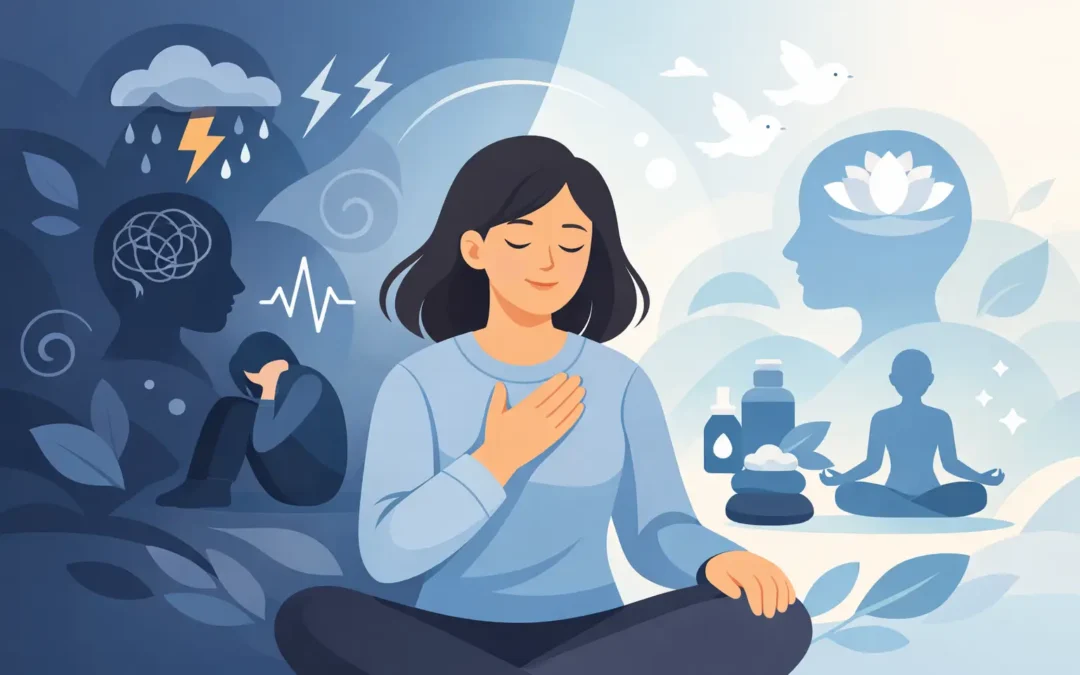
A panic attack can make an ordinary moment feel like an emergency. Your chest tightens, your thoughts race, your body goes on high alert, and suddenly you are not asking abstract questions about mental health – you are asking what the best relief for anxiety and panic attacks really is, right now, in real life.
The honest answer is this: the best relief is not one single trick. It is a combination of immediate tools that help your nervous system settle and deeper support that addresses why anxiety keeps taking over in the first place. Quick coping skills matter. Lasting healing matters too. When both are in place, people often stop feeling like they are just surviving and start feeling like themselves again.
What actually helps in the moment
When anxiety spikes or a panic attack hits, your body is not being dramatic. It is reacting as if danger is present, even when no real threat is in front of you. That is why logic alone usually does not work fast enough. In the moment, the goal is not to argue with panic. The goal is to help your brain and body register safety.
Slow, steady breathing can help, but only if it does not become another thing to fail at. For some people, taking one longer exhale than inhale is more effective than trying to force deep breaths. A simple pattern like breathing in for four and out for six can begin to reduce the alarm response. If counting makes you more anxious, it is okay to drop the numbers and focus only on softening your exhale.
Grounding also works because panic pulls you out of the present. Touching a cool countertop, pressing your feet into the floor, or naming what you can see around you can interrupt the spiral. This may sound small, but small signals of safety can be powerful when your nervous system is overwhelmed.
Another form of relief is reducing the secondary fear. Many people are not only afraid during a panic attack – they become afraid of the panic attack itself. They worry they are losing control, having a heart problem, or about to collapse. Reminding yourself, as gently as possible, that panic is intense but temporary can take some fuel out of the fire. Not all of it, but often enough to help the wave pass.
The best relief for anxiety and panic attacks is not always obvious
People often search for the one thing that will make anxiety disappear forever. That makes sense. When you are exhausted, you want certainty. But anxiety is personal, and the best relief for anxiety and panic attacks depends on what is driving them.
For one person, panic may be tied to unresolved trauma. For another, it may be connected to chronic stress, burnout, grief, relationship conflict, lack of sleep, or a body that has been stuck in survival mode for too long. Some people need practical tools first. Others need emotional processing. Others do best with a blend of therapy and brain-based support.
This is where people can get discouraged. If basic coping tips have not fixed the problem, it does not mean you are failing. It usually means your anxiety needs a more complete approach.
Why coping skills help – and why they are not the whole answer
Coping skills are valuable. They can shorten the length of a panic attack, reduce fear, and help you function through hard moments. They can make driving possible again, help you get through a workday, or allow you to fall asleep without spiraling.
But coping skills alone do not always create deep change. If your nervous system is carrying old stress, trauma, or constant overwhelm, then anxiety may keep returning even when you know exactly what to do. That can feel frustrating and defeating.
The truth is that symptom relief and root-level healing are different goals. Both matter. If you only focus on short-term relief, you may feel stuck in management mode. If you only focus on deep healing without enough day-to-day tools, life can still feel unsteady. A strong treatment plan usually includes both.
Therapy can create lasting relief
Good therapy does more than teach you to calm down. It helps you understand your triggers, patterns, relationships, emotional wounds, and survival responses. It gives context to what your mind and body have been doing. That matters, because anxiety often loses some of its power when it starts making sense.
For panic attacks, therapy can help identify the cycle that keeps them going. You may notice catastrophic thoughts, body scanning, avoidance, and fear of fear itself. Working through these patterns with a skilled therapist can reduce the intensity and frequency of attacks over time.
If trauma is part of the picture, trauma-focused approaches such as EMDR may be especially helpful. When panic is rooted in unresolved experiences, simply talking about symptoms may not be enough. The nervous system often needs a way to process what has remained stuck.
For some people, relief also comes from being deeply seen by another person without judgment. That should not be underestimated. Anxiety can be isolating. Healing often starts when you no longer have to carry it alone.
Brain-based support can help a dysregulated nervous system
Some clients know their anxiety is irrational and still cannot stop the body response. They understand the pattern intellectually, but their system keeps firing like the danger is real. In those cases, brain-based approaches can be a meaningful part of treatment.
Neurofeedback is one example. It is designed to support healthier brain functioning and help the nervous system become less reactive. For people who feel trapped in hypervigilance, panic, mental fog, or chronic overstimulation, this kind of support can complement counseling in a way that feels practical and hopeful.
That does not mean it is a magic fix or the right choice for every person. Some people respond quickly. Others need a layered plan that includes therapy, lifestyle changes, and nervous system regulation tools. The key is personalization, not pressure.
Lifestyle factors matter more than most people want to hear
This is not the glamorous answer, but it is a real one. Sleep deprivation, caffeine sensitivity, alcohol use, blood sugar swings, and nonstop stress can all make anxiety worse. They may not be the root cause, but they can absolutely raise the volume.
If panic attacks seem to come out of nowhere, it is worth paying attention to the basics. Are you running on empty? Are you pushing through emotional pain without rest? Are your habits keeping your body in a constant state of activation?
This is not about blame. It is about giving your system a fair chance to stabilize. Sometimes small shifts in sleep, nourishment, movement, and stimulation can create enough breathing room for deeper healing work to be more effective.
When to get professional help for anxiety and panic attacks
If anxiety is changing how you live, it is time to reach out. That includes avoiding places, canceling plans, struggling at work, feeling afraid to be alone, having repeated panic attacks, or feeling constantly on edge. You do not need to wait until things get unbearable.
Professional support is especially important when panic is accompanied by depression, trauma symptoms, relationship strain, or a sense that your usual coping tools are no longer working. These are not signs of weakness. They are signs that your system needs care.
At Jump Start Counseling and Neurofeedback, this often means looking at the whole picture – thoughts, emotions, relationships, body-based stress, and brain patterns – so treatment can move beyond temporary survival and toward real change.
Relief is possible, even if anxiety has been running the show
Anxiety can convince you that this is just how life will feel now. Tight chest. Racing mind. Dread before simple tasks. Fear of the next panic attack. But people do get better. Not because they learn to fake calm, but because they build safety, support, and healing from the inside out.
The best relief for anxiety and panic attacks is the kind that meets you where you are today and helps you create a different tomorrow. If all you can do right now is slow one breath, plant your feet, and ask for help, that is not a small beginning. That is how change starts.
